
Collections Framework Introduction
Here you will learn what collections are and how they can make your job easier and programs better.
The Collections Framework, first introduced with the Java 2 platform, Standard
Edition, version 1.2. The Collections Framework provides a well-designed set of interfaces and classes for storing and manipulating groups of data as a single unit, a collection.
What is Collection?
A collection sometimes called a container. It is the collection of objects known as its elements, collect into a single place and treated as a single unit. these objects can be a store, retrieve,
manipulate as an element of a collection. Some collections allow duplicate elements and others do not. Some are ordered and others unordered.
- Interfaces: These are abstract data types that represent collections. Interfaces allow collections to be manipulated independently of the details of their representation.
- Implementations: These are the concrete implementations of the collection interfaces. In essence, they are reusable data structures.
- Algorithms: These are the methods that perform useful computations, such as searching and sorting, on objects that implement collection interfaces.
Collections Framework are divided into two part.
- Interfaces
- Classes
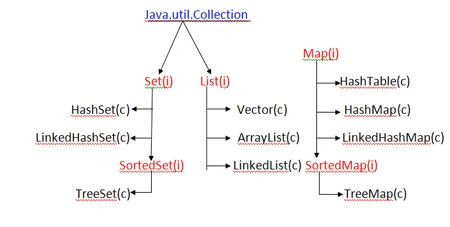
Classes implement these interfaces that are found in java.util package.
Interfaces
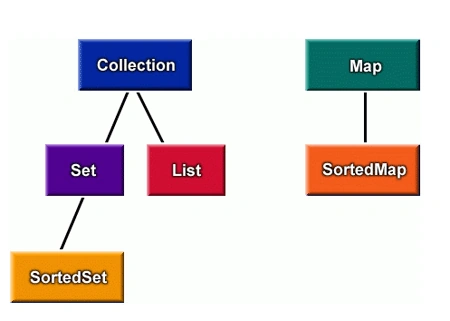
In the Collections
Framework, the interfaces Map and Collection are distinct with no lineage in the hierarchy. The typical application of the map is to provide access to values stored by keys.
When designing software with the Collection Framework, it is useful to remember
the following hierarchical relationship of the four basic interfaces of the
framework.
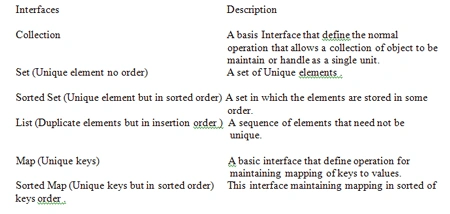
The Collection interface is a group of objects,
with duplicates allowed.
Set extends Collection but forbids duplicates.
List extends Collection also, allows duplicates and introduces positional
indexing.
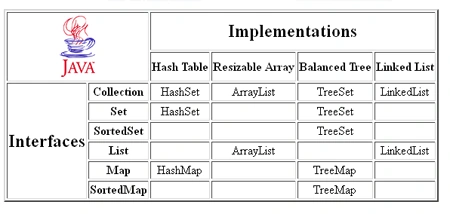
Corresponding Implementations
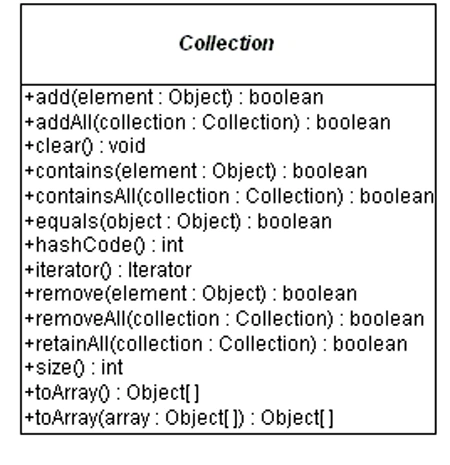
In this program, we use Array List Class and.
Create a Java program by using Eclipse ID. Open
the Eclipse and Follow these steps
Step-1
Create a Java project and give the name
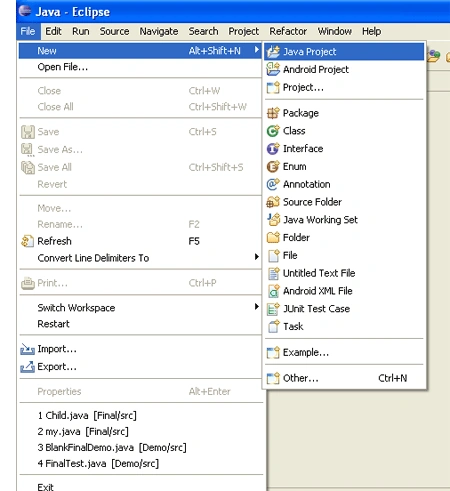
Step-2
Here the name is Collection Demo.
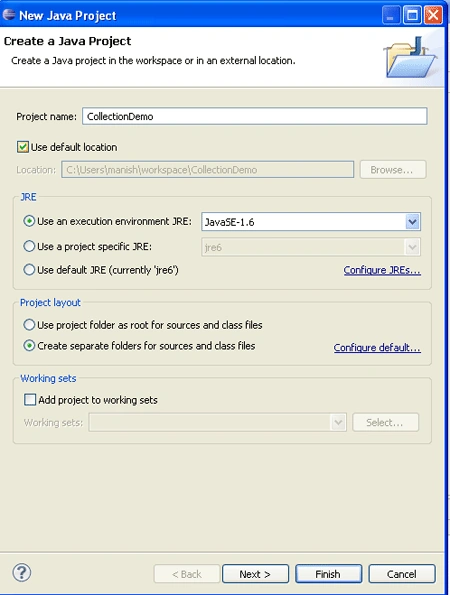
Step-3
Create the Class and gave the name
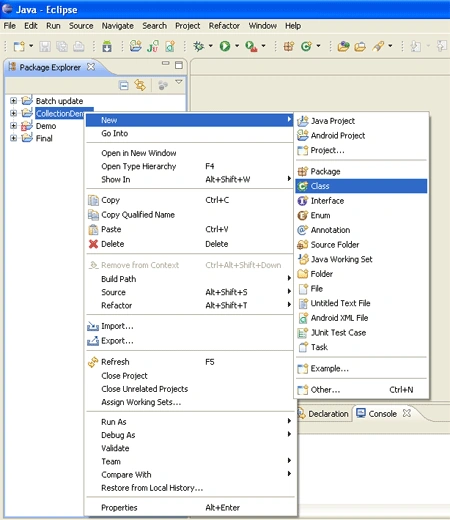
Step-4
Here the name of the class CollectionDemo. In this
program, we insert some object into the array list by using add() method of
Collection interface. The syntax of add() method is defined below.
- public boolean add(Object o)
- we also use remove() and size() method in this program.import java.util.ArrayList;
- public class CollectionDemo {
- public static void main(String arg[]) {
- @SuppressWarnings("rawtypes")
- ArrayList < Comparable > al = new ArrayList < Comparable > ();
- System.out.println("initial state array list size=" + al.size());
- al.add("b");
- al.add("h");
- al.add(new Integer(10));
- al.add("a");
- al.add("c");
- al.add("g");
- al.add("f");
- System.out.println("after inserting 7 elements array list size=" + al.size());
- System.out.println("printing array list items =" + al);
- al.remove(3);
- System.out.println("after deleting 1 element from the array list then size =" + al.size());
- System.out.println("printing array list items =" + al);
- }
- }
Step-5
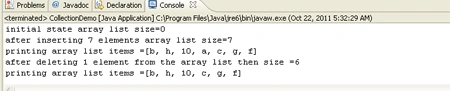
Compile and run the program, the output of the program is given below.
Join the conversation! Your thoughts help the community grow.