Introduction
This article is intended to show information about Windows Workflow Foundation (WWF) of key part of Microsoft.NET 3.0 technologies suite. I will illustrate the concepts and the main components of this technology.
WWF
WWF is the new Microsoft initiative to define, execute and manage workflows. It provides a singular engine to execute workflows. It also supports human workflow (person-centric) as well as highly structured application-centric workflows.
The WWF Engine
The WWF engine is the hosting environment which allows the execution and management of workflows.
The architecture of WWF engine is illustrated in the Figure 1. You can see that WWF doesn't have an intrinsic execution process (at the bottom of the figure); instead, it is an in-process engine that runs inside a host process. There are available a variety of host process for WWF such as console applications, WinForms applications, ASP.NET applications, Web Services applications, Windows services, and SharePoint server.
Now, we're going to analyze each layer in the WWF architecture. The hosting layer provides interfaces between WWF and the host environment which supports the following services: Communication, Persistence, Tracking, Timer, Threading and Transaction. In this way, WWF can take advantage of the capabilities in specific hosts. Persistence service allows storing the state of workflow beyond its execution, because some workflows may execute in short period of time, but other workflows may take days, even months. The Timer service allows the engine to wait for an event to continue. The Tracking service provides interfaces to receive tracking events from the runtime and pass to the host applications to persist this tracking information. Communication service allows receiving and sending message to the host. The messages trigger workflow, and move activities sequences in the workflow. The interfaces may implement any communication protocol, thus in this level we have an independent layer from the outside.
The runtime layer is the most important component of WWF technology. The components of this layer provide critical services such as execution, tracking, state management, scheduler and rules. The execution service schedules activities and supports common behaviors such as event handling, exceptions, tracking, and transactions. The tracking service creates the tracking information that is sent through the tracking interface. The state management service manages the state to be persisted through the persistence interface. The scheduler service creates the plans for the workflow's execution. And finally, the rules service provides policy execution functionality.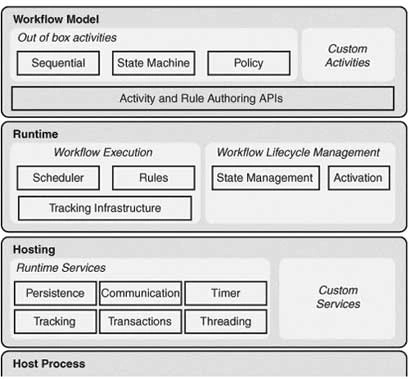
Figure 1.
The workflow model comprises model types, activities, and the main programming API use by developers writing code for WWF.
In WWF, you can find to model to specify the workflow:

Join the conversation! Your thoughts help the community grow.