

Today, I will take a new part of Python for my tutorial series. In this part you
will learn about Object Oriented in Python.
I already told you the following:
- Installation of Python
- Python Language Tutorial: Part One
- Python Language Tutorial: Part Two
- Python Language Tutorial: Data Structure in List - Part Three
- Python Language Tutorial: Module and Input Output - Part Four
- Python Language Tutorial: Exception Handling - Part Five
- Python Language Tutorial: Regular Expression - Part Six
Python has been an Object oriented Programming language and also supports all concept of OOPS.
Python has many OOPS terminologies:
- Class
- Inheritance
- Method
- Object
- Instance
- Function Overloading
These are the basic OOPS concepts and Python supports all concepts.
Create Class:
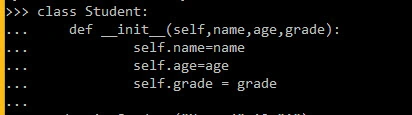
- Firstly open python terminal and in Command Prompt of Windows and write code as below:
class Student:
o def __init__(self,name,age,grade):
- self.name=name
- self.age=age
- self.grade = grade
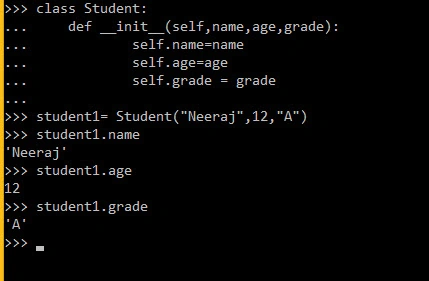
- Now make Object of class and insert value of Student like below:
Student1 = Student(“Neeraj”,12,”A”)
Class Attributes:
These Class attributes built-in attributes that can use for specific task.
- __dict__: Dictionary containing the class's namespace.
- __doc__: Class documentation string or none, if undefined.
- __name__: Class name.
- __module__: Module name in which the class is defined. This attribute is "__main__" in interactive mode.
- __dict__: A possibly empty tuple containing the base classes, in the order of their occurrence in the base class list.
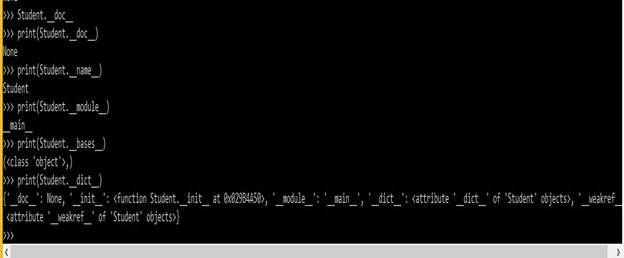
- Now we example of all the above attributes.
- print(Student.__doc__)
- print(Student.__name__)
- print(Student.__module__)
- print(Student.__bases__)
- print(Student.__dict__)
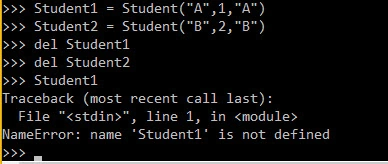
- Creation and Deletion of Object is easy in python as below code:
- Student1 = Student("A",1,"A") // create student1 object
- Student2 = Student("B",2,"B") // “”
- del Student1 // delete the object student1
- del Student2 //””
class Student:
- def __init__(self,name,age,grade):
a. self.name=name
b. self.age=age
c. self.grade = grade
- def displayStudent(self):
a. return ("Student name is "+self.name+" and age is "+str(self.age))
- student1=Student("BOB",21,"A")
- student1.displayStudent()
Class Method Built-In:
• getattr(obj, name[, default]) : to access the attribute of object.
• hasattr(obj,name) : to check if an attribute exists or not.
• setattr(obj,name,value) : to set an attribute. If attribute does not exist, then it would be created.
• delattr(obj, name) : to delete an attribute
- Let's take an example of these Methods
class Student:
- def __init__(self,name,age
- self.name=name
- self.age=age
- self.grade = grade
- Student1 = Student("A",21,"A")
- hasattr(Student1,"age")
- hasattr(Student1,"marks")
- setattr(Student1,"marks","75")
- hasattr(Student1,"marks")
- getattr(Student1,"grade")
- getattr(Student1,"name")
- delattr(Student1,"marks")
- hasattr(Student1,"marks")
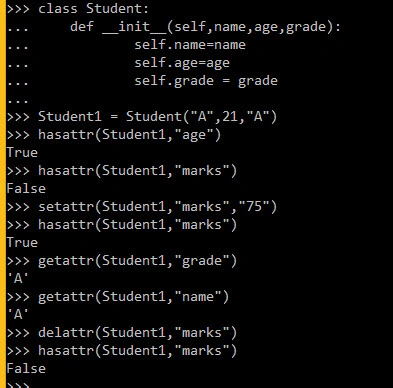
- def __init__(self,name,age
Sothis article has basic of class and mainly I define the Built-In features of Class in python. Remaining concept of OOPS work the same as another Programming language.
Join the conversation! Your thoughts help the community grow.