

Introduction
Mocha is one of the well-known frameworks for JavaScript unit testing. If you are very new to JavaScript unit testing, then please visit my previous article.
In the previous article, I covered the basic unit testing concept with Jasmine. Now, in this part, I am going to discuss one more framework, Mocha, and the assertion framework, chai.js.
Mocha is a testing JavaScript framework so it is hosted on node.js. It is easy to understand and also, the reporting feature of Mocha is good. So, without wasting time, we can start learning about it.
First, visit here for downloading and installing Mocha.
Two options are available here using npm.
- Local (only for the project)
npm install --save-dev mocha
- Globalnpm install --global mocha
Create a simple application using Mocha
I have installed Mocha globally.
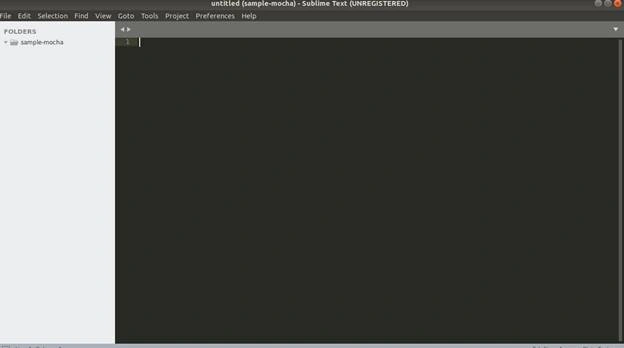
Now create a folder and open that in any IDE/Editor, like Sublime Text or Visual Studio Code (Here, I have used Sublime Text).
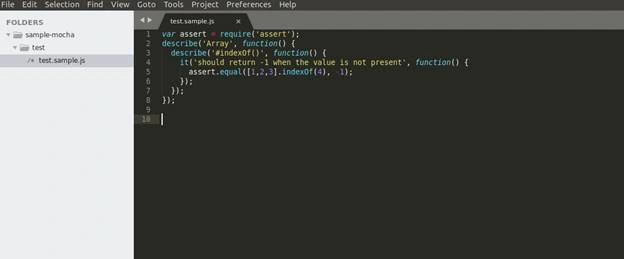
Create a test folder and inside that, add one file named first.test.js.
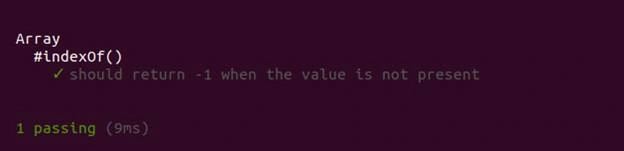
Open the terminal and use the command
mocha
Note
If you are using local Mocha installer, then instead of it, use ./node_modules/mocha/bin/mocha
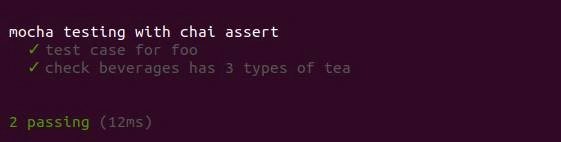
Also, you can change in package.json.
- "scripts": {
- "test": "mocha"
- }
Then, one can use the command to run the application - npm test
While writing a test case, we have got two keywords.
- Describe- Describe is a group of test cases that can be used to test a specific behavior or functionality of the JavaScript application. The describe function contains two parameters name and function. In this function, we can add one or many descriptions of its block.
- It- it is like an individual test case.
It is also having the same two params as describe - name of "it" feature, and function. This function contains the actual code alone with assertions. We will see what is an assertion in detail.
Test execution hooks
Hooks mean some methods where we can write the common code which executes before and after the test case.
- describe('calculator application', function() {
- before(function() {
- // runs before all tests in this block
- });
- after(function() {
- // runs after all tests in this block
- });
- beforeEach(function() {
- // runs before each test in this block
- });
- afterEach(function() {
- // runs after each test in this block
- });
- // test cases
- it('addition',function() {
- //addition test case logic
- });
- it('subtraction',function() {
- //subtraction test case logic
- });
- it('multiplication',function() {
- //multiplication test case logic
- });
- it('division',function() {
- //division test case logic
- });
- });
Join the conversation! Your thoughts help the community grow.