
What is Stored Procedure?
A stored procedure is a formulated SQL code you can save to keep reusing the code. One or more T-SQL statements into a logical unit are stored in the server database as an object. If a saved procedure is initially called in the SQL Server, it creates a plan and stores it in the cache. SQL Server reuses the plan when executing the saved procedure so, that a reliable performance can be performed very quickly.
What are CRUD Operations?
CRUD operations include the fundamental operations Insert, Read, Update, and Delete.
- C – CREATE
- R – READ
- U – UPDATE
- D- DELETE
Let’s start with the code :)
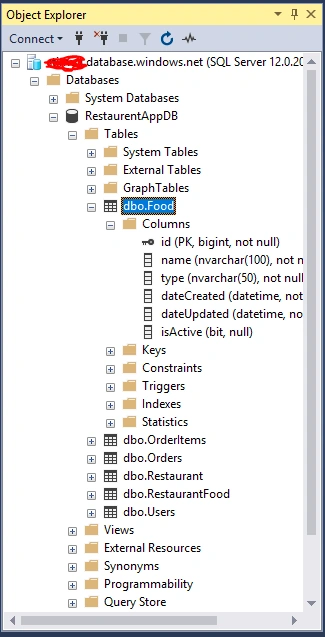
Create Operation
- IF @action = 'INSERT'
- BEGIN
- INSERT INTO Food (
- [name],[type],[dateCreated],[dateUpdated],[isActive] ) VALUES (
- @name,@type,GETDATE(),GETDATE(),@isActive)
- END
Read Operation
- IF @action = 'SELECT'
- BEGIN
- SELECT [id],[name],[type],[dateCreated],[dateUpdated],[isActive]
- FROM [Food]
- WHERE (@id = 0 OR [id] = @id) AND (@name = '' OR [name] = @name) AND (@type = '' OR [type] = @type)
- END
Update Operation
- IF @action = 'UPDATE'
- BEGIN
- UPDATE Food SET
- [name] = ISNULL(ISNULL(NULLIF(@name,' '), NULL), [name]),
- [type] = ISNULL(ISNULL(NULLIF(@type,' '), NULL), [type]),
- [dateUpdated] = GETDATE()
- WHERE [id] = @id
- END
Delete Operation
- IF @action = 'DELETE'
- BEGIN
- DELETE FROM Food
- WHERE [id] = @id
- END
Activate/ Deactivate Operation
- IF @action = 'ACTIVATE-DEACTIVATE'
- BEGIN
- UPDATE Food SET
- [isActive] = @isActive
- WHERE [id] = @id
- END
Final Stored Procedure
- CREATE PROCEDURE [dbo].[food_curd_sp] (
- @action AS VARCHAR(25) = '',
- @id AS INT = 0,
- @name AS NVARCHAR(100) ='',
- @type AS NVARCHAR(50) ='',
- @isActive AS BIT = 1
- ) AS
- BEGIN
- IF @action = 'SELECT'
- BEGIN
- SELECT [id],[name],[type],[dateCreated],[dateUpdated],[isActive]
- FROM [Food]
- WHERE (@id = 0 OR [id] = @id) AND (@name = '' OR [name] = @name) AND (@type = '' OR [type] = @type)
- END
- ELSE IF @action = 'INSERT'
- BEGIN
- INSERT INTO Food (
- [name],[type],[dateCreated],[dateUpdated],[isActive] ) VALUES (
- @name,@type,GETDATE(),GETDATE(),@isActive)
- END
- ELSE IF @action = 'UPDATE'
- BEGIN
- UPDATE Food SET
- [name] = ISNULL(ISNULL(NULLIF(@name,' '), NULL), [name]),
- [type] = ISNULL(ISNULL(NULLIF(@type,' '), NULL), [type]),
- [dateUpdated] = GETDATE()
- WHERE [id] = @id
- END
- ELSE IF @action = 'ACTIVATE-DEACTIVATE'
- BEGIN
- UPDATE Food SET
- [isActive] = @isActive
- WHERE [id] = @id
- END
- ELSE IF @action = 'DELETE'
- BEGIN
- DELETE FROM Food
- WHERE [id] = @id
- END
- END
Result
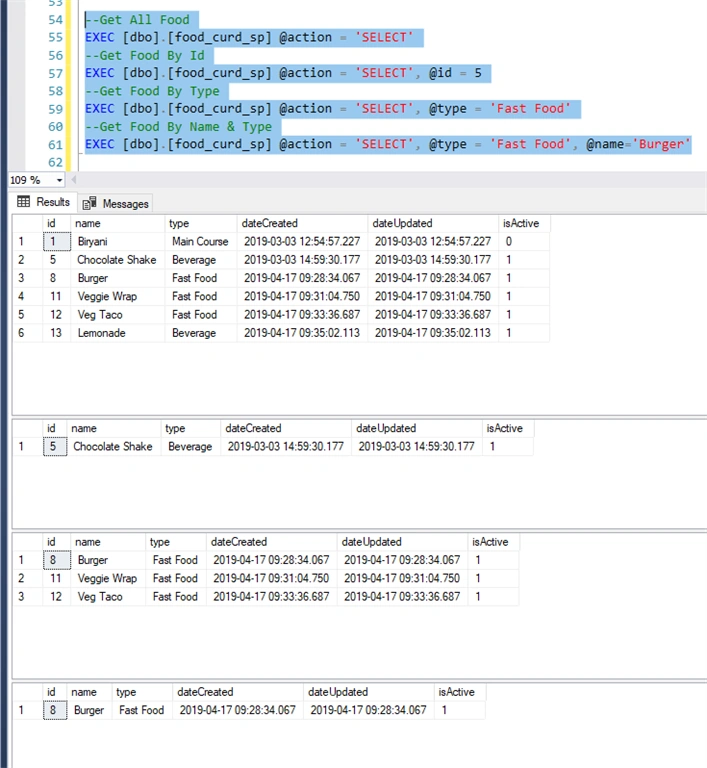
Select Operation
- EXEC [dbo].[food_curd_sp] @action = 'SELECT'
- EXEC [dbo].[food_curd_sp] @action = 'SELECT', @id = 5
- EXEC [dbo].[food_curd_sp] @action = 'SELECT', @type = 'Fast Food'
- EXEC [dbo].[food_curd_sp] @action = 'SELECT', @type = 'Fast Food', @name='Burger'
Insert Operation
- EXEC [dbo].[food_curd_sp] @action = 'INSERT', @name='Lemonade', @type ='Beverage'
Update Operation
- -- Update only name
- EXEC [dbo].[food_curd_sp] @action = 'UPDATE', @id = 13, @name='Mint Lemonade'
- -- Update only type
- EXEC [dbo].[food_curd_sp] @action = 'UPDATE', @id = 13, @type='Cold Drink'
- -- Update both name & type
- EXEC [dbo].[food_curd_sp] @action = 'UPDATE', @id = 13, @name='Lemonade', @type='Cold Drink'
Activate/ De-Activate
- -- Activate
- EXEC [dbo].[food_curd_sp] @action = 'ACTIVATE-DEACTIVATE', @id = 1, @isActive = 1
- -- De-Activate
- EXEC [dbo].[food_curd_sp] @action = 'ACTIVATE-DEACTIVATE', @id = 1, @isActive = 0
Delete
- -- Delete By Id
- EXEC [dbo].[food_curd_sp] @action = 'DELETE', @id=10
Benefits of using this approach
With the help of this syntax, you don't have to write multiple queries with different WHERE clauses in case you want to read the data from a table. Also, if you want to update a few columns for each task, then you don't have to write a separate query for the task.
Note
This approach is still not perfect. If you optimize this, please describe your changes in the Comments section :)
This approach is still not perfect. If you optimize this, please describe your changes in the Comments section :)
Jitendra GangwarPosted Nov 14, 2019, 2:25 AM
Nice Article....