

In this tutorial, we will see a better approach towards the registration and login process in an ASP.NET, using C#, where will see hash passwords and how we manage the password correctly in login form. Also, we will see how to authenticate the duplicate user during the registration process.
Prerequisites
- Datatable having columns as username, password and an E-mail.
- Store Procedure, where one for inserting and one for authentication.
- 3 Web Forms – Register.aspx, login.aspx, home.aspx
Initial Chamber
Step 1
Open Your Visual Studio 2015 and create an empty Website. Give a suitable name [RegForm_demo].
Step 2
In Solution Explorer, you get your empty Website, followed by adding three Web Forms and SQL Server database.
For Web Form
RegForm_demo (Your Empty Website) -> Right click -> Add New Item -> Web Form. Name it as Register.aspx. Now, go to the same process, add other Web form and name it --> login.aspx and home.aspx.
For SQL Server database
RegForm_demo (Your Empty Website) -> Right click -> Add New Item -> SQL Server database. Add the database inside the App_Data_folder.
Database Chamber
Step 3
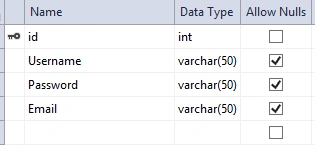
In Server Explorer, click on your database [Database.mdf] - -> Tables - -> Add New Table - -> Make the table, as shown below.
Store Procedure
sp_insert
- CREATE PROCEDURE [dbo].[sp_insert]
- (
- -- Add the parameters for the stored procedure here
- @Username varchar(50),
- @Password varchar(50),
- @Email varchar(50)
- )
- as
- Begin
- Declare @Count int
- Declare @codereturn int
- Select @Count = COUNT(Username)
- from tbl_data where Username = @Username
- If @Count > 0
- Begin
- Set @codereturn = -1
- End
- Else
- Begin
- Set @codereturn = 1
- Insert into tbl_data values(@Username,@Password,@Email)
- End
- Select @codereturn as ReturnValue
- End
sp_select
- CREATE PROCEDURE sp_select
- @Username varchar(50),
- @Password varchar(50)
- AS
- BEGIN
- Declare @Count int
- Select @Count = COUNT(Username)
- from tbl_data where [Username] =@Username and [Password] =@Password
- If (@Count = 1)
- Begin
- Select 1 as codereturn
- End
- Else
- Begin
- Select -1 as codereturn
- End
- END
Design code
Step 4
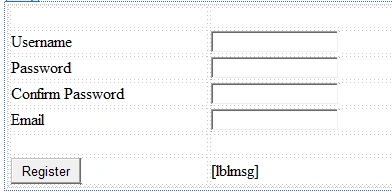
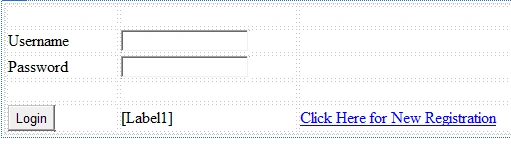
Now, make some design for your Application by going to Register.aspx and design it, as shown below.
Register.aspx
Login.aspx
Code Chamber
Step 5
We will make some code in Register.aspx.cs page, so that our Register form works.
Register.aspx.cs
- using System;
- using System.Collections.Generic;
- using System.Linq;
- using System.Web;
- using System.Web.UI;
- using System.Web.UI.WebControls;
- using System.Data.SqlClient;
- using System.Data;
- using System.Data.Sql;
- using System.Web.Security;
- namespace WebApplication3
- {
- public partial class Register : System.Web.UI.Page
- {
- protected void Button1_Click(object sender, EventArgs e)
- {
- SqlConnection con = new SqlConnection(@"Data Source=Nilesh;Initial Catalog=test_db;Integrated Security=True");
- SqlCommand cmd = new SqlCommand("sp_insert", con);
- cmd.CommandType = CommandType.StoredProcedure;
- string encryp = FormsAuthentication.HashPasswordForStoringInConfigFile(TextBox2.Text, "SHA1");
- cmd.Parameters.AddWithValue("@Username", TextBox1.Text);
- cmd.Parameters.AddWithValue("@Password", encryp);
- cmd.Parameters.AddWithValue("@Email", TextBox4.Text);
- con.Open();
- int codereturn = (int)cmd.ExecuteScalar();
- if (codereturn == -1)
- {
- lblmsg.Text = "Username already exist!";
- lblmsg.ForeColor = System.Drawing.Color.Red;
- }
- else
- {
- Response.Redirect("~/Login.aspx");
- }
- }
- }
- }
Login.aspx.cs
- using System;
- using System.Collections.Generic;
- using System.Linq;
- using System.Web;
- using System.Web.UI;
- using System.Web.UI.WebControls;
- using System.Data;
- using System.Data.SqlClient;
- using System.Web.Security;
- namespace WebApplication3
- {
- public partial class Login : System.Web.UI.Page
- {
- protected void Button1_Click(object sender, EventArgs e)
- {
- if (authenticate(TextBox1.Text, TextBox2.Text))
- {
- Response.Redirect("~/Home.aspx");
- }
- else
- {
- Label1.Text = "Invalid Username and Password";
- Label1.ForeColor = System.Drawing.Color.Red;
- }
- }
- private bool authenticate(string Username, string Passsword)
- {
- SqlConnection con = new SqlConnection(@"Data Source=Nilesh;Initial Catalog=test_db;Integrated Security=True");
- SqlCommand cmd = new SqlCommand("sp_select", con);
- cmd.CommandType = CommandType.StoredProcedure;
- string encryp = FormsAuthentication.HashPasswordForStoringInConfigFile(TextBox2.Text, "SHA1");
- cmd.Parameters.AddWithValue("@Username", TextBox1.Text);
- cmd.Parameters.AddWithValue("@Password",encryp);
- con.Open();
- int codereturn = (int)cmd.ExecuteScalar();
- return codereturn == 1;
- }
- }
- }
Output
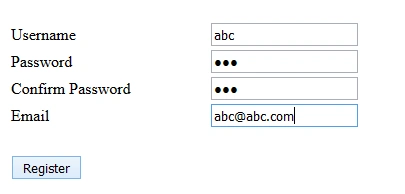
The user is registering with the username abc and password abc too, and if successful, the login page will open, else the respective error message will be shown. Also, this data is saved in the database, as shown below. You can see the password is encrypted in hash format.

Let’s say, the user abc is registered and now another user comes. Register with the same username as abc and the authenticate procedure will call and an error will be shown, as given below.
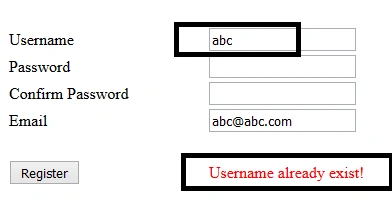
Login page output
After successful registration, the user abc can access his account, using login access.
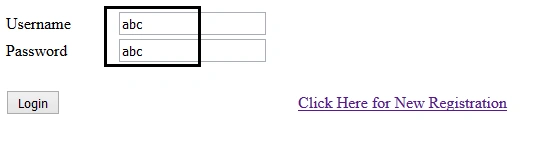
If login is successfuk, home page will be opened, else the respective error will be shown.

Hope, you liked it. Have a good day and thank you for reading.
kaushal kishorePosted May 8, 2019, 1:21 AM
This is not fully secured as password is passing in plain text from client to server. password must be encrypted before passing in authenticate(string Username, string Passsword) method.
Arvind MorePosted Apr 17, 2017, 7:24 AM
Simple and Most useful using stored Procedure....... Thanks Bhava
kzelda linkPosted Apr 16, 2017, 5:14 AM
Using "if exists" sql statement , is more faster than count.