

Introduction
Sometimes the client wants to get the data from the single sheet of Excel file and show that specific data on the page using C# in ASP.NET so this article explains how to do that.
At the start I need to create an Excel file to get the data, so there is a file named "MyExcel.xlsx" with 2 columns with some data like: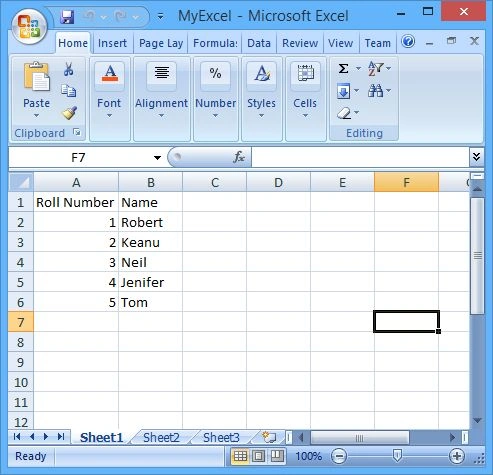
Note: I have not changed the sheet name in the Excel file, otherwise I need to get the sheet name. You can also find the Excel file inside the attached documents.
Now to get the data from the preceding Excel file, I need to work on a page as in the following:
- Add the "FileUpload" Control to upload the file.
- Add a GridView to show the data.
- Add a button with click event.
- Write some code in the code file for the button click event.
To learn more about this, check the following procedure.
Step 1
Add a new "Website" named "Website1" as in the following: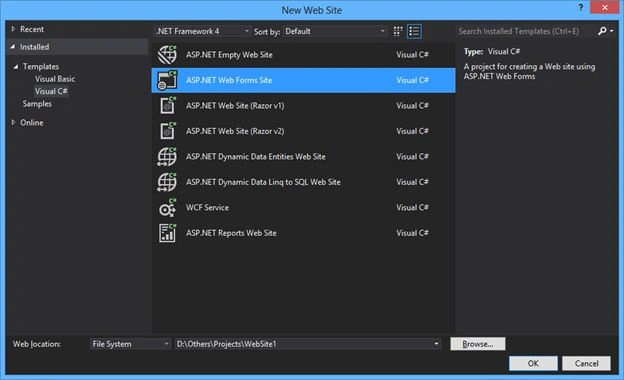
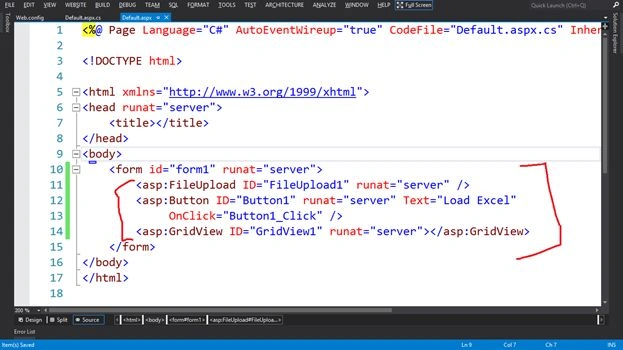
Add some controls on the default page named "Defaut.aspx" as in the following:
- Add the "FileUpload" control to upload the file.
- Add a GridView to show the data.
- Add a button with click event.
- <asp:FileUpload ID="FileUpload1" runat="server" />
- <asp:Button ID="Button1" runat="server" Text="Load Excel"
- OnClick="Button1_Click" />
- <asp:GridView ID="GridView1" runat="server"></asp:GridView>
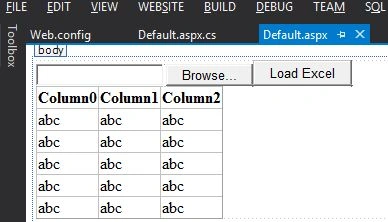
The page will look like as in the following:
Step 2
Add 2 namespaces on the top of the code file.
- using System.IO;
- using System.Data.OleDb;
- using System.Data;
- "System.IO" is used for the "File" and "Path" classes to access the Excel file.
- "System.Data.OleDb" is used for the "OleDbConnection" and "OleDbConnection" classes to connect with the Excel file.
- "System.Data" is used for the "DataTable" class.
Note: Microsoft Excel is like a database and OleDb is used to connect with many kinds of database.
Add the following code for the button click event.
- protected void Button1_Click(object sender, EventArgs e)
- {
- //if File is not selected then return
- if (Request.Files["FileUpload1"].ContentLength <= 0)
- { return; }
- //Get the file extension
- string fileExtension = Path.GetExtension(Request.Files["FileUpload1"].FileName);
- //If file is not in excel format then return
- if (fileExtension != ".xls" && fileExtension != ".xlsx")
- { return; }
- //Get the File name and create new path to save it on server
- string fileLocation = Server.MapPath("\\") + Request.Files["FileUpload1"].FileName;
- //if the File is exist on serevr then delete it
- if (File.Exists(fileLocation))
- {
- File.Delete(fileLocation);
- }
- //save the file lon the server before loading
- Request.Files["FileUpload1"].SaveAs(fileLocation);
- //Create the QueryString for differnt version of fexcel file
- string strConn = "";
- switch (fileExtension)
- {
- case ".xls": //Excel 1997-2003
- strConn = "Provider=Microsoft.Jet.OLEDB.4.0;Data Source=" + fileLocation
+ ";Extended Properties=\"Excel 8.0;HDR=Yes;IMEX=1\""; - break;
- case ".xlsx": //Excel 2007-2010
- strConn = "Provider=Microsoft.ACE.OLEDB.12.0;Data Source=" + fileLocation
+ ";Extended Properties=\"Excel 12.0 xml;HDR=Yes;IMEX=1\""; - break;
- }
- //Get the data from the excel sheet1 which is default
- string query = "select * from [Sheet1$]";
- OleDbConnection objConn;
- OleDbDataAdapter oleDA;
- DataTable dt = new DataTable();
- objConn = new OleDbConnection(strConn);
- objConn.Open();
- oleDA = new OleDbDataAdapter(query, objConn);
- oleDA.Fill(dt);
- objConn.Close();
- oleDA.Dispose();
- objConn.Dispose();
- //Bind the datatable to the Grid
- GridView1.DataSource = dt;
- GridView1.DataBind();
- //Delete the excel file from the server
- File.Delete(fileLocation);
- }
Note: I have not changed the sheet name of the Excel file, otherwise I need to get the sheet name.
Step 3
Run the page.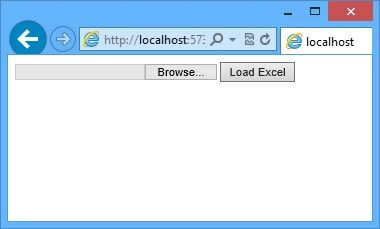
Select the Excel file that was created first and click on the "Load Excel" Button. Here is the result.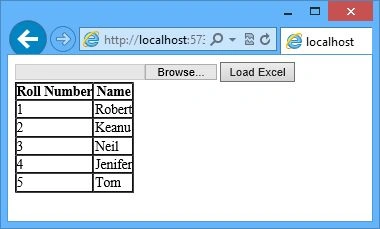
RakeshPosted Mar 17, 2015, 1:25 PM
Nice..can we also do this with SSIS?
Ankit BansalPosted Mar 17, 2015, 4:30 AM
good..
Vijay SPosted Mar 16, 2015, 5:49 AM
Nice