

TreeView control used to represent hierarchical data using expandable nodes. TreeView control is available in window forms and WPF as well.
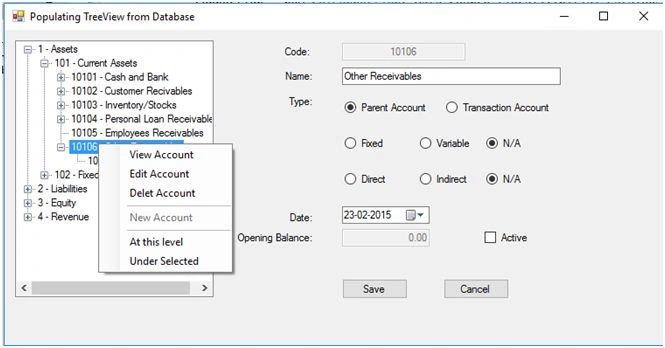
This article will guide you “How to populate and add new nodes to TreeView up-to N Levels from Database”. You will be able to add new node at any level and expand this up-to N Levels and generate automatic code for any child.
1. Database Structure
Firstly, create database table with the given model. We will use only one table, as we have to expand it to N level. I have used SQL Server 2014. Any version of SQL server can be used.
- CREATE TABLE [dbo].accounts(
- [code] [int] NOTNULL,
- [ac_name] [nvarchar](50)NOTNULL,
- [parent] [int] NOTNULL,
- [type] [nvarchar](20)NOTNULL,
- [levelno] [int] NOTNULL,
- [fixed] [nvarchar](50)NULL,
- [direct] [nvarchar](50)NULL,
- [open_bal] [decimal](18, 2)NULL,
- [dt] [datetime] NULLCONSTRAINT [DF_chart_dt] DEFAULT (getdate()),
- [active] [int] NOTNULLCONSTRAINT [DF_chart_active] DEFAULT ((1)),
- [cntr] [int] IDENTITY(1,1)NOTNULL,
- CONSTRAINT [PK_chart] PRIMARYKEYCLUSTERED
- (
- [code] ASC
- )WITH (PAD_INDEX=OFF,STATISTICS_NORECOMPUTE=OFF,IGNORE_DUP_KEY=OFF,ALLOW_ROW_LOCKS=ON,ALLOW_PAGE_LOCKS=ON)ON [PRIMARY]
- )ON [PRIMARY]
2. Add some dummy data to this table
- GO
- SETIDENTITY_INSERT[dbo].accounts ON
- GO
- INSERT[dbo].accounts([code], [ac_name], [parent], [type], [levelno], [fixed], [direct], [open_bal], [dt], [active], [cntr]) VALUES(1, N 'Assets', 0, N 'Parent Account', 0, N 'NA', N 'NA', CAST(0.00 ASDecimal(18, 2)), CAST(N '2015-02-23 21:09:27.327'
- ASDateTime), 1, 1)
- GO
- INSERT[dbo].accounts([code], [ac_name], [parent], [type], [levelno], [fixed], [direct], [open_bal], [dt], [active], [cntr]) VALUES(2, N 'Liabilities', 0, N 'Parent Account', 0, N 'NA', N 'NA', CAST(0.00 ASDecimal(18, 2)), CAST(N '2015-02-23 21:09:27.327'
- ASDateTime), 1, 2)
- GO
- INSERT[dbo].accounts([code], [ac_name], [parent], [type], [levelno], [fixed], [direct], [open_bal], [dt], [active], [cntr]) VALUES(3, N 'Equity', 0, N 'Parent Account', 0, N 'NA', N 'NA', CAST(0.00 ASDecimal(18, 2)), CAST(N '2015-02-23 21:09:27.327'
- ASDateTime), 1, 3)
- GO
- INSERT[dbo].accounts([code], [ac_name], [parent], [type], [levelno], [fixed], [direct], [open_bal], [dt], [active], [cntr]) VALUES(4, N 'Revenue', 0, N 'Parent Account', 0, N 'Variable', N 'Indirect', CAST(0.00 ASDecimal(18, 2)), CAST(N '2015-02-26 00:00:00.000'
- ASDateTime), 1, 38)
- GO
- INSERT[dbo].accounts([code], [ac_name], [parent], [type], [levelno], [fixed], [direct], [open_bal], [dt], [active], [cntr]) VALUES(101, N 'Current Assets', 1, N 'Parent Account', 1, N 'NA', N 'NA', CAST(0.00 ASDecimal(18, 2)), CAST(N '2015-02-23 21:09:27.327'
- ASDateTime), 1, 4)
- GO
- INSERT[dbo].accounts([code], [ac_name], [parent], [type], [levelno], [fixed], [direct], [open_bal], [dt], [active], [cntr]) VALUES(102, N 'Fixed Assets', 1, N 'Parent Account', 1, N 'NA', N 'NA', CAST(0.00 ASDecimal(18, 2)), CAST(N '2015-02-23 21:09:27.327'
- ASDateTime), 1, 5)
- GO
- INSERT[dbo].accounts([code], [ac_name], [parent], [type], [levelno], [fixed], [direct], [open_bal], [dt], [active], [cntr]) VALUES(201, N 'Short Term Liabilities', 2, N 'Parent Account', 1, N 'NA', N 'NA', CAST(0.00 ASDecimal(18, 2)), CAST(N '2015-02-23 21:09:27.327'
- ASDateTime), 1, 6)
- GO
- INSERT[dbo].accounts([code], [ac_name], [parent], [type], [levelno], [fixed], [direct], [open_bal], [dt], [active], [cntr]) VALUES(202, N 'Long Term Liabilities', 2, N 'Parent Account', 1, N 'NA', N 'NA', CAST(0.00 ASDecimal(18, 2)), CAST(N '2015-02-23 21:09:27.327'
- ASDateTime), 1, 7)
- GO
- SETIDENTITY_INSERT[dbo].accounts OFF
- GO
After creating the table and adding data to it, now we are able to populate data into TreeView.
Here are the steps:
- Create a winform project in Visual Studio.
- Drag and drop a tree view to the form.
- Add a context menu to the form. This context menu will be used to perform the following function,
a. View the data of specific node
b. Adding node at current level
c. Adding new node under the selected node
- Double click on form and create the Form_Load event. We will populate tree at the loading time of the form.
- While form will be loading, we will fetch the data from SQL Server and save it to the datatable.
- The following function will populate the data into the TreeView.
- PopulateTreeView is a recursive function. It calls itself until no more nodes are available to show in TreeView.
- private void PopulateTreeView(int parentId, TreeNode parentNode)
- {
- TreeNode childNode;
- foreach(DataRow dr in _acountsTb.Select("[parent]=" + parentId))
- {
- TreeNode t = new TreeNode();
- t.Text = dr["code"].ToString() + " - " + dr["ac_name"].ToString();
- t.Name = dr["code"].ToString();
- t.Tag = _acountsTb.Rows.IndexOf(dr);
- if (parentNode == null)
- {
- treeView1.Nodes.Add(t);
- childNode = t;
- }
- else
- {
- parentNode.Nodes.Add(t);
- childNode = t;
- }
- PopulateTreeView(Convert.ToInt32(dr["code"].ToString()), childNode);
- }
- }
The following function is used to display details of a specific node.
- private void ShowNodeData(TreeNode nod)
- {
- DataRow r = _acountsTb.Rows[int.Parse(nod.Tag.ToString())];
- txtCode.Text = r["code"].ToString();
- txtName.Text = r["ac_name"].ToString();
- dtpDate.Value = DateTime.Parse(r["dt"].ToString());
- textBox1.Text = r["open_bal"].ToString();
- if (r["type"].ToString().Equals("Parent Account"))
- {
- radioParent.Checked = true;
- textBox1.Enabled = false;
- }
- else radioTransaction.Checked = true;
- if (r["fixed"].ToString().Equals("NA")) radioNA1.Checked = true;
- elseif(r["fixed"].ToString().Equals("Fixed"))
- radioFixed.Checked = true;
- else radioVariable.Checked = true;
- if (r["direct"].ToString().Equals("NA")) radioNA2.Checked = true;
- elseif(r["direct"].ToString().Equals("Direct"))
- radioDirect.Checked = true;
- else radioIndirect.Checked = true;
- txtName.Focus();
- }
The following event handler handles the click action of context menu item “At this level”. This event first create code for the new item to be inserted.
- privatevoid atThisLevelToolStripMenuItem_Click(object sender, EventArgs e)
- {
- _selectedNode = treeView1.SelectedNode;
- int max = 0;
- if (treeView1.Nodes.Count > 0)
- {
- _parent = int.Parse(_acountsTb.Rows[int.Parse(_selectedNode.Tag.ToString())]["parent"].ToString());
- DataRow[] nodes = _acountsTb.Select("[parent]=" + _parent);
- foreach(DataRow r in nodes)
- {
- int n = int.Parse(r["code"].ToString());
- if (n > max) max = n;
- }
- }
- max += 1;
- txtCode.Text = max.ToString();
- _newNode = true;
- _thisLevel = true;
- txtName.Focus();
- }
The following event handler handles the click action of context menu item “Under Select”. This event first create code for the new item to be inserted.
- private void underSelectedToolStripMenuItem_Click(object sender, EventArgs e)
- {
- _selectedNode = treeView1.SelectedNode;
- DataRow r = _acountsTb.Rows[int.Parse(treeView1.SelectedNode.Tag.ToString())];
- if (r["type"].ToString().Equals("Parent Account"))
- {
- _newNode = true;
- _thisLevel = false;
- string code = string.Empty;
- _parent = int.Parse(_acountsTb.Rows[int.Parse(_selectedNode.Tag.ToString())]["code"].ToString());
- if (_selectedNode.Nodes.Count > 0)
- {
- DataRow[] nodes = _acountsTb.Select("[parent]=" + _parent);
- int max = 0;
- foreach(DataRow ra in nodes)
- {
- int n = int.Parse(ra["code"].ToString());
- if (n > max) max = n;
- }
- max += 1;
- txtCode.Text = max.ToString();
- code = max.ToString();
- }
- else
- {
- if (_selectedNode.Level < 3) code = "01";
- else code = "001";
- txtCode.Text = r["code"] + code;
- }
- txtName.Focus();
- }
- else
- {
- _newNode = false;
- MessageBox.Show("New Account can't be opened under a Transaction Account", "Acount opening Failed", MessageBoxButtons.OK, MessageBoxIcon.Error);
- }
- }
The above tutorial shows you, how we can dynamically create and populate TreeView in C# up-to N Levels. We can generate code automatically at any level.
Read more articles on SQL Server:
Keorapetsi MatsemePosted Jun 13, 2019, 3:18 AM
Great work, Do you have the same solution for mvc Web?
Jet WellPosted Mar 29, 2019, 2:18 PM
Thanks a lot kashif sohail you provide a great work for me and i wish you more knowlege as you hope.
imran tanvirPosted Nov 3, 2017, 11:36 AM
I have 5 database tables. its char of accounts upto 5 levels. coa1, coa2,coa3,coa4,coa5. coa5 is the functional accounts. now i want populate treeview from database, treeview should be in proper listing of coa. how can i do it.
SubashPosted Sep 7, 2016, 8:11 AM
Good one
Delpin Susai RajPosted Aug 28, 2016, 9:34 AM
Nice
Syed ShanuPosted Feb 11, 2016, 3:28 AM
Nice one Kashif and keep on posting articles
Shubham KumarPosted Feb 10, 2016, 4:46 AM
nice keep share
Sibeesh VenuPosted Feb 10, 2016, 1:54 AM
Nice Share
Raja TPosted Feb 9, 2016, 11:45 PM
Nice, Thanks for sharing