

Introduction
This article explains the differences between the ASP.NET Model View Controller (MVC) and the ASP.NET Web API and will also explain when to use the Web API with the MVC.
Overview of MVC
Model View Controller (MVC) divides an application into three parts, Model, View, and Controller. ASP.NET has many options for creating Web applications using the ASP.NET Web forms. MVC framework Combines ASP.NET features such as Master pages and membership-based authentication. MVC exists in the "System.Web.MVC" assembly.
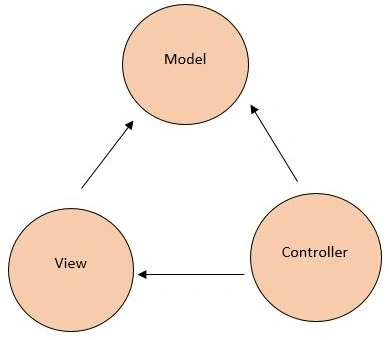
The components that are included by the MVC.
- Models: Models are the objects used to retrieve and store the model state in the database. Let's see an example. There is an "item" object that fetches the data from the database and performs an operation and then stores the updated data into the database. If an application only reads the dataset and sends it to the view then the application does not have any associated class and physical layer model.
- View: View components show the User Interface (UI) of the applications that is created by the data model. For example, the view of the Items table shows the drop-down list and textboxes that depend on the current state of the "item" object.
- Controllers: In MVC, controllers are also called the components. These components manage the user interaction and choose a view for displaying the UI. The main work of the controller is to manage the query string values and transfer these values to the models.
The Models retrieve the information and store the updated information in the database. Views are used for only displaying the information, and the controllers are used for managing and responding to the user inputs and their interactions.
Overview of the Web API
The ASP.NET Web API allows for displaying the data in various formats, such as XML and JSON. It is a framework that uses the HTTP services and makes it easy to provide the response to the client request. The response depends on the clients' requests. The web API builds the HTTP services and manages the request using the HTTP protocols. The Web API is open source and it can be hosted in the application or on the IIS. The request may be GET, POST, DELETE, or PUT. We can say that the Web API.
- Is an HTTP service.
- Is designed for reaching a broad range of clients.
- Uses the HTTP application.
Difference between MVC and Web API
There are many differences between MVC and Web API, including.
- We can use the MVC for developing the Web application that replies as both data and views but the Web API is used for generating the HTTP services that reply only as data.
- In the Web API, the request performs tracing with the actions depending on the HTTP services but the MVC request performs tracing with the action name.
- The Web API returns the data in various formats, such as JSON, XML, and other formats based on the accept header of the request. However, the MVC returns the data in the JSON format by using JSONResult.
- The Web API supports content negotiation, self hosting. All of these are not supported by the MVC.
- The Web API includes the various features of the MVC, such as routing, and model binding but these features are different and are defined in the "System.Web.Http" assembly. The MVC features are defined in the " System.Web.Mvc" assembly.
- The Web API helps the creation of RESTful services over the .Net Framework but the MVC does not support it.
When we combined the MVC with Web API?
- When we do the self-hosting on the application, in it we combine both the MVC controller and the API in a single project and it helps for managing the AJAX requests and returns the response in XML, JSON, and other Formats.
- We combined the MVC and Web API to enable the authorization for an application. In it, we create two filters, one for the Web API and another for MVC.
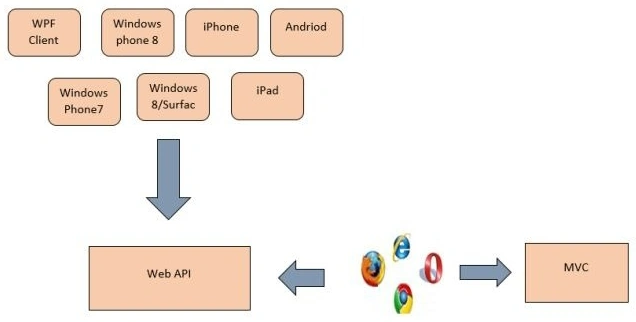
This figure describes the combination of ASP.NET MVC and ASP.NET Web API.
Soumyadip MajumderPosted Aug 19, 2025, 6:51 AM
When to use .NET Web API as backend and .NET MVC as frontend? And, when to use MVC as backend and frontend for proejct? I know, .NET Web API is for Backend part, MVC (Model-View-Controller) use for frontend part.
Sumit TilekarPosted Mar 23, 2021, 1:07 PM
Nice artical
jerson gerongPosted Feb 11, 2018, 8:23 PM
Nice article, really give a knowledge about the difference of the two. Thanks!
Debasis SahaPosted Jun 20, 2015, 1:40 AM
Good one