

Introduction
This article will discuss the base of Apache, Cassandra, and Cassandra 2.0 by comparing them. Here I am also including some new features that are available in Cassandra 2.0.
This article is the first in a series.
What is Apache Cassandra?
Apache Cassandra is a scalable open-source NoSQL database. It is used for managing or handling a humongous amount of data. This humongous amount of data can be of any type (Structured, Unstructured, or Semi-structured) among various data centers and the cloud too.
Why Apache Cassandra?
Cassandra works like a free and handy architecture. It sports the same nodes. Here are some features that you need to know in order to answer, why to use Apache Cassandra
- Continuous data availability
- Linear Scalability
- Operational simplicity
- Works simply with every commodity server
- No single point of failure
- Powerful dynamic data
- Maximum flexibility
- Fast respond times
- Automatic database distribution
- High-performance rate
How Apache Cassandra Works?
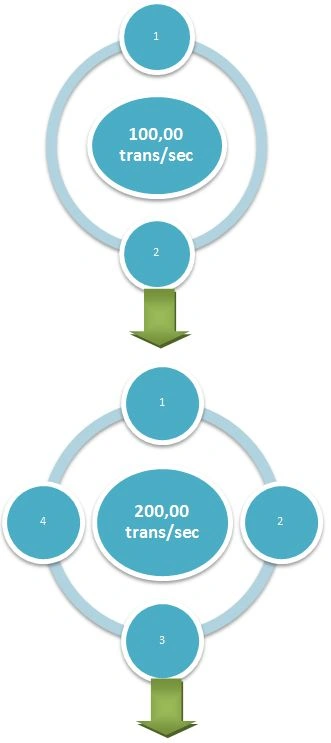
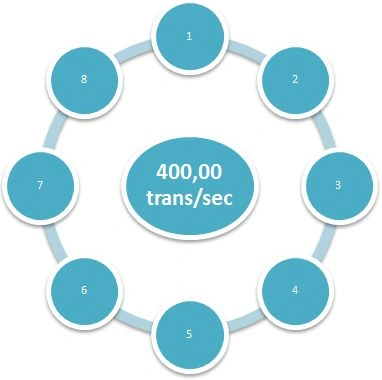
As I mentioned above that Apache Cassandra works with all the same level nodes, in other words, there is no secondary level in it. Cassandra provides automatic distribution of data across all the nodes available in that database cluster.
There is nothing related to the programming that a developer or database admin needs to do. There is no coding required to distribute data across a cluster because data is already portioned across all the nodes in a cluster.
What's new in Cassandra?
Key features of Cassandra 2.0 are as follows
- It supports lightweight transactions
- There is a new serial consistency level
- Use of the IF keyword in CQL
There are several other new features in Cassandra 2.0.,
Drop Column Support
Authentication
- Is improved and modified
- SASL support added
- CQL native protocol
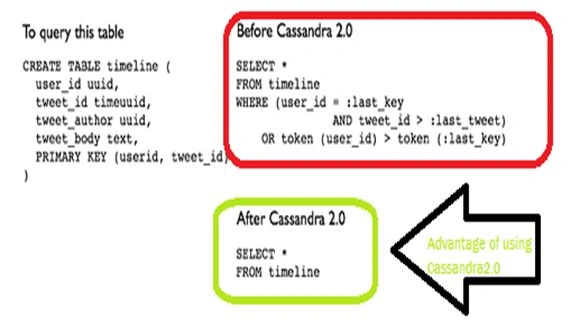
Bind Variable support
- Better server-side parsing
- Execution is performed using a BATCH message
- It contains a list of query strings.
- There is no reparsing in it.
Triggers
It supports TRIGGERS, which helps in firing an event that executes a set of programmatic logic, that generally runs inside or outside a database cluster.
Index Enchantments
- Compaction improvement
- Off heap partition
Some other base changes in Apache Cassandra 2.0 are as follows
- There are several new commands for disabling background compactions.
- Cqlsh COPY command for giving support to the collections.
- Use of NATIVE PROTOCOL version in the system local table.
- Support for an empty list of values.
- Useful in Java DRIVER applications.
- AUTO BOOTSTRAPPING functionality.
For more info and the following parts keep visiting. I hope you will like this.
Abhishek JaiswalPosted Aug 29, 2014, 1:23 AM
Hey rajeev, what kinda practical implementation u want ?
Rajeev RanjanPosted Aug 28, 2014, 1:34 AM
Dear Abhishek , your article is such a knowledgeable article indeed. whatever you were written there can you show me (like practically) , cuz one of my frnd asked me same , and i wasn't prove it. It would be a kind help for me , if you can .
Abhishek JaiswalPosted May 8, 2014, 10:34 AM
thank u sir for ur kind review! :_
Gopi ChandPosted May 8, 2014, 9:14 AM
Well explained abhishek....thanks for sharing such an article..