

Executive Summary
One of the most dangerous assumptions an engineer can make is treating a TCP socket like a distinct message queue. TCP is a continuous stream of bytes. It does not respect your application's logical boundaries.
When a backend parser correctly splits multiple commands from a single TCP buffer, but fails to isolate the authorization state for each of those commands, the trust boundary collapses.
In Phase 05A of my 16-Phase Offensive Socket Security research, we are dissecting Parser State Desynchronization . We will look at the raw C# socket architecture, weaponize a payload to bypass authorization, and define the real-world impact of state bleed.
The Real-World Mapping
This vulnerability does not exist in standard HTTP REST APIs. It thrives in lower-level, persistent connection architectures. You will find this specific desynchronization class in:
Line-based internal TCP services: Custom microservices communicating over raw sockets.
Legacy admin command daemons: Server management ports that accept sequential text commands.
Stateful socket APIs: Systems where a user authenticates once and the connection remains open for subsequent actions.
Multi-step workflow systems: Parsers that rely on temporary memory flags to track the current stage of a transaction.
The Vulnerable Architecture (C# Lab)
In this lab, we built a C# socket listener that passes the raw network buffer into a parsing method. The parser correctly attempts to create boundaries using the \n delimiter to handle multiple commands sent at once.
However, the critical flaw lies in memory scoping: the isAuthorized boolean is declared outside of the message parsing loop.
static void ParseMessage(string rawBuffer)
{
    // The server attempts to create boundaries using '\n'
    string[] messages = rawBuffer.Split(new[] { '\n' }, StringSplitOptions.RemoveEmptyEntries);

    // VULNERABILITY: State is scoped to the TCP buffer, not the individual message!
    bool isAuthorized = false;

    foreach (var msg in messages)
    {
        Console.WriteLine($"[PARSE] Evaluating boundary: [{msg}]");

        if (msg.StartsWith("AUTH:GUEST"))
        {
            isAuthorized = true; // Auth succeeds for the guest
            Console.WriteLine("[AUTH] Guest access granted.");
        }
        else if (msg.StartsWith("CMD:EXPORT_USERS"))
        {
            // The smuggled message inherits the authorization state of the previous message!
            if (isAuthorized)
            {
                Console.WriteLine("[EXEC] Unauthorized user export executed!");
            }
            else
            {
                Console.WriteLine("[DENIED] Unauthorized command.");
            }
        }
    }
}
The Exploit Breakdown
If a user connects and attempts to send CMD:EXPORT_USERS on its own, the parser evaluates the command, sees isAuthorized is false, and drops the request.
To bypass this, the attacker exploits the pipelining nature of TCP by packing two commands into a single byte stream.
The Attacker Payload:
AUTH:GUEST\nCMD:EXPORT_USERS\nThe Execution Flow:
[PARSE]
AUTH:GUEST- The loop reads the first command.[AUTH] Session accepted. - The system grants low-privilege guest access and flips
isAuthorized = true.[PARSE]
CMD:EXPORT_USERS- The loop instantly iterates to the next logical boundary in the same buffer array.[EXEC] Unauthorized export executed. - The Desynchronization. The message boundaries reset inside the loop, but the authorization state did not. The restricted command inherits the elevated state of the previous command.
The system correctly parsed the text, but it completely desynchronized the trust boundaries.
Proof of Concept: Observing State Bleed in Real-Time
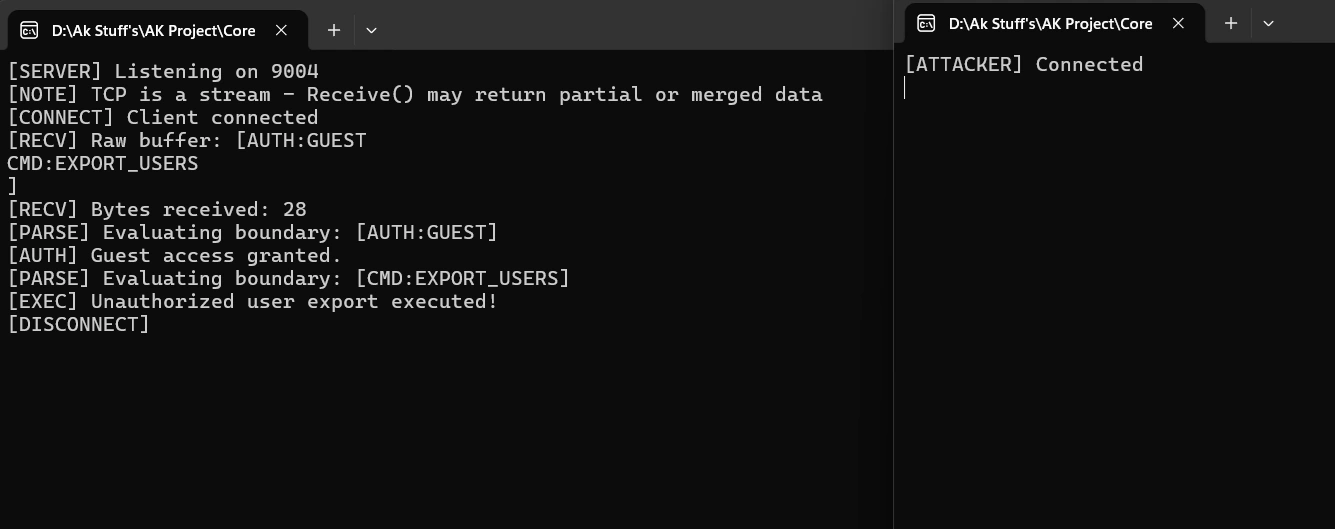
Figure 1: The attacker pipelines two commands. The parser successfully splits them but fails to reset the authorization state, allowing the restricted export to execute.
Security Impact & Industry Mapping
When temporary state outlives the message that created it, the resulting impact is critical.
Privilege Escalation: Low-privilege actions successfully chain into administrative execution.
Authorization Bypass: Security checks are satisfied by phantom state data.
Hidden Command Execution: Malicious commands are masked behind legitimate precursor traffic.
CWE Mapping
CWE-863: Incorrect Authorization
CWE-284: Improper Access Control
CWE-20: Improper Input Validation
The Defensive Fix: Atomic Authorization
To patch this protocol flaw, you must enforce Atomic Authorization. State must be explicitly scoped to the individual logical message, never to the TCP buffer or the parsing loop.
Scope auth state per message: Move the
bool isAuthorized = false;declaration inside theforeachloop.Parse one complete command at a time: Reset temporary flags immediately after a command is validated or executed.
Use explicit framing: Move away from delimiter-based parsing and implement length-prefixed protocols to guarantee message integrity.
Final Insight
Parser split correctly. State isolation failed. That is Parser State Desynchronization.
This article is part of Phase 05 of my ongoing 16-Phase Offensive Socket Security research.
🔗 Full 16-Phase GitHub Repository:
[https://github.com/AnshuKulhade/offensive-socket-security-16-phase]
🔗 Phase 05A Source Code & POC:
In the next article, we will look at how this concept evolves when applied to shared Keep-Alive connection pools, leading to Backend Response Queue Poisoning.
Join the conversation! Your thoughts help the community grow.